What is the Employee Provident Fund? PF Transferred but Pension Fund Not Transferred Why? What Happens to Pension Amount If Employee Dies Before 58 Years?
What is the Employee Provident Fund?
The Employee Provident Fund (EPF) is a scheme that helps people save up a sufficient corpus for retirement. The plan was introduced with the Employees’ Provident Funds Act in 1952 and is today managed by the Employees’ Provident Fund Organisation (EPFO).
In this scheme, an employee has to contribute 12% of their basic income towards the fund every month. The employer matches this amount with an equal contribution. When you retire, you receive the total amount (personal as well as the employer’s contribution) as a lump sum along with interest. The EPF is regarded as a low-risk investment as the Government of India manages it and assures a fixed rate of return.
Companies with a minimum of 20 employees must maintain EPF accounts for their employees. Some companies with fewer than 20 employees also adopt the EPF scheme. We shall discuss this in detail later on.
Also, the provision of an EPF account is compulsory for employees with a salary of less than ₹15000. That said, most companies provide the facility to all employees regardless of their salary. And if you move from one job to another, you can transfer your EPF corpus easily. This is possible through something known as the Universal Account Number (UAN).
Why Pension Contribution is Not Transferred in EPF?
The purpose of EPF pension is to give security to the EPF member after retirement, so when you transfer your PF amount then your new PF passbook will not show the transferred pension contribution. But still the pension fund transfers.
If your total service is below 10 yrs then you can withdraw that amount after leaving your job. If your service reaches above 10 yrs then you will get a monthly pension amount after 58 yrs of your age.
What is The Pension Fund in PF Passbook
Like an employee, every employer will also contribute 12% of employee 7basic salary to the PF account of the employee. But in which only 3.6% will go to the PF account of the employee and the remaining 8.33% will be deposited to the pension account of the employee. This will be considered as a pension fund of the employee.
EPF members can withdraw this before 10yrs of service, after 10 yrs they can’t able to withdraw it. Either they have to wait until 58yrs of age or they can get a scheme certificate.
Also read: PF claim settled but money not credited
How Can I Know that My Pension Service Period Transferred or Not
EPF members can check their service history easily at the UAN member portal. For that log in to UAN member portal in menu bar go to view option, and click on service history
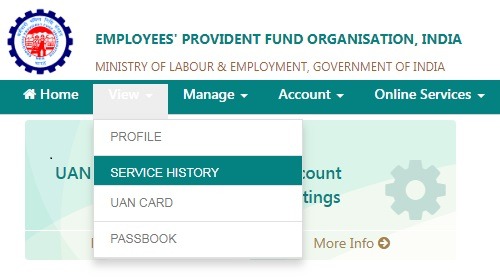
Once you click on service history then your service history associated with various PF accounts linked to that UAN number will appear.

Can I Withdraw or Transfer My Pension, Which is Best?
The primary aim of EPF is to support the employees after their retirement, especially pension is the major support to the private employees when they become old. So it is always better to transfer your pension amount whenever you change your job.
Still, you have an option to withdraw your PF amount whenever you need it, like in the form of PF advance or complete PF withdrawal after leaving the job. So don’t touch your pension amount until you complete 58 years and use the benefit of EPS monthly pension after your retirement.
Will I Get Pension Really After Retirement
Yes, without any doubt you will get your monthly pension after retirement, for that, you need to submit form 10D to your PF office either offline or online. Some employees withdraw their pension because of fear of doubt about the monthly pension.
But you don’t need to have any such kind of doubts because EPFO is very genuine in settling claims and it is under the control of the central government, so you don’t need to worry about it.
What Happens to Pension Amount If Employee Dies Before 58 Years
Unfortunately, if the employee dies before 58 years then the nominees / legal heirs will get that monthly pension for that they need to submit form 20 and form 10D to their regional EPF office.
Every EPF member who is contributing to EPF will also become eligible for EDLI (Employee Deposit Linked Insurance) Scheme. Under this scheme also nominees will get some amount, for that they need to submit form 5IF.
Comments
Post a Comment